Last week I was invited to participate in a LAWST-style workshop on Technical Debt. I was honored to be there with such a great group of people from diverse industries and experiences.
Preface: I am writing this blog entry for myself and therefore it may not be as useful to those reading. Also, the perspective on discussion points are from my own understanding. I will link to other portrayals, blogs, and articles on technical debt in the future to round out these understandings. I do have positions on this topic that I have talked about in earlier posts, conference presentations, and in articles that I will continue to build upon in the future with influence from people in the workshop and outside, as well.
On the night before the workshop began, a large group of the participants went out to a Grand Rapids, MI watering hole to get introduced and start lively discussions. I learned some interesting nuggets such as how some roads in Texas are paved cow runs. We also discussed more of the philosophical and metaphorical underpinnings of the term debt in relation to technology artifacts. One item I took away from this was around discretionary income. Some technology shops either do not have discretionary income or choose to use it developing new capabilities rather than investing it to minimize their current technical debt.
Nancy Van Schooenderwoert provided me with many good pieces of information. While discussing our agile coaching experiences with teams she said:
“The only question that matters at the end of an iteration is ‘Did you build more or less trust with the customer?'”
Some people who read this may find this difficult to find true but I have found this question is important to ask each iteration. Scrum and other agile frameworks attempt to build trust between parties that may have played the blame-game with each other in past projects. As a team and customer build trust the motivation of the team and willingness of a customer to collaborate grows stronger. These characteristics enable faster product development with higher quality.
Now for the play-by-play of the workshop itself.
Rick Hower: 10 Warning Signs of Technical Debt
Rick facilitated a brainstorming session to gather warning signs of technical debt in your code. We brainstormed way more than 10 warning signs that I did not write down. Rick and potentially other participants will be writing an article to choose the top 10 warning signs that I will link to once it comes out.
Matt Heusser: Root Causes of Technical Debt
Here are some of the notes I took on Matt’s topic:
Typical training in computer science tends to not entail testing, maintenance of your own code beyond an assignment, or team interaction.
Technical people tend to take a victim position when developing code too fast creating technical debt. For instance “those mean business people pushed me around and I have no power to change their mind”. Non-technical people don’t always understand what they are asking for when making decisions on feature delivery. If they knew the impact of these decisions they may decide to pay off some of the technical debt before investing in new features.
North American businesses tend to look for short-term versus long-term results. This could impact planning and delivery since the short-term goals may be hacks while long-term results show decay of software can be costly.
Engineers have observable physical reasons for qualifying assessments (ie. “This bridge will take traffic going 40 mph”). Software development organizations do not seem to have these types of qualifying assessment tools fully figured out yet. Matt used mechanical engineering in the 1800’s versus electrical engineering during the same time period to support this idea. Mechanical engineering was well established in the late 1800’s yet electrical engineering was still in its infancy. Useful units to measure were known for mechanical engineering yet the electrical engineering folks did not have similar units of measure. Over time the electrical engineering discipline gained new knowledge and developed useful units of measure that we use today. Maybe we as the software industry are still trying to find our useful units of measure.
David Walker: False Starts
Misuse and bad deployment of practices hurts an organization.
David mentioned an organization that may be of interest: ACQ (American Society for Quality). They have a topic on their site called ECQ (Economic Case for Quality) that may be a helpful talking point.
Chris McMahon asked the question “Why would you not do excellent work?” in a discussion on technical people asking for permission to work on technical debt in their software development efforts. I thought this was a great question so I wrote it down.
Steve Poling: Technical Debt is Fascism
Steve got our attention with the name of this topic. Steve wanted us to come up with formulas we could use to calculate technical debt. I thought he had some good ideas and I hope he is able to develop formulas that actually work for particular instances of technical debt.
Steve brought up Godwin’s Law: “As a Usenet discussion grows longer, the probability of a comparison involving Nazis or Hitler approaches one.” I thought this was interesting since the term technical debt could be dilluted in its usage if it covers too much of a spectrum and is not able to be pinned down.
I thought Steve brought up a fairly good metaphor for technical debt revolving around his trailer hitch. He had noticed the need to paint his trailer hitch for some time in order to protect it from the elements. The problem was that other pressing items of business came up and he did not paint the hitch. Over time he went to paint the trailer hitch and now it had rust on it. This meant that the total effort to protect the trailer hitch from the elements had grown exponentially. He now had to clean the hitch and make sure the rust was gone and then he could paint it.
Ron Jeffries asked to draw a picture on the black board to discuss technical debt and he came up with what I thought was an amazing representation of the issue. Here is my attempt at recreating his phenomenal chalk talk in a tool:

We can make incremental progress on a large feature area within a system adding value with each addition. In order to make incremental progress we should keep code clean and easy to change so the addition of more features on top of existing functionality does not slow down. In fact we should be able to deliver features faster on top of each capability already built into system. This does not always (or even usually for that matter) happen in projects and instead we end up with a “big ball of mud” to work with. As a team is working on this system they begin an effort to add a new feature and get caught in a quagmire of old crusty code that is difficult to work with. What is even worse is when there are external dependencies to this big ball of mud that makes changes even more risky than it would be on its own.
David Christiansen: Where did all this $@#% come from?
David was entertaining and provided some instances of what he constituted as technical debt. Here are the sources he listed in the presentation:
- Taking shortcuts (experienced)
- Hacks (beginner)
- Geniuses (overcomplicated)
- Living in the now
- Futurists
- Time
- The Iron Triangle
- Anticipating reuse
- Documentation
- Innovation
- Trying to avoid technical debt
Some people in the room thought this list went well beyond what technical debt should be. This list seems to cover almost anything that causes software to become difficult to work with. It was a great list of issues and David went on to say he wasn’t as interested in defining technical so much as help to create tools and practices that would minimize bad software.
David also discussed how documentation is a gamble:
“Like a slot machine the house always wins. Sometimes you get a winner but most of the time it is a loss.”
I will probably use this quote in the future with proper acknowledgements so thank you David.
Brian Marick said the following during the questions and answers portion of the presentation:
“Debt is a property between the people and the code.”
I thought this was interesting and already have multiple thoughts on how this can be applied. I am not sure what is the best way to view this statement yet I found it important enough to write down so I will think about it some more. Also, I hope to ask Brian more about this point in the future.
Michael Feathers also brought to the group a point about the tradeoffs made in terms of “navigability versus changeability in the code”. Some technical folks like code navigation to be explicit and therefore have difficulty reading strongly object-oriented code that separates implementation from interfaces to support change.
Nancy Van Schooenderwoert: A Garden of Metaphors
Nancy proposed that we could start to explain technical debt more succinctly if given a combination of a metaphor and metrics. The metaphor can help people who are non-technical understand the impact of their decisions on technical artifacts. For instance the use of the word debt helps people visualize the problems with just making it work versus craftsmanship (word brought up by Matt Heusser that I thought was useful). She mentioned that technical debt is about expectation setting.
NOTE: Nancy wrote to me and added the following comment - “Metrics and Metaphor have opposite weaknesses so they support each other well. People can be suspicious of metrics, because there is an infinite choice of things to measure and how to measure them. Metaphor, on the other hand rings true because of familiar experiences the listener has had. The only problem is that it depends on tech debt *truly* being like the thing in the metaphor. We have to check back with reality to know if that’s the case. That implies we measure something to see whether and how the behavior of tech debt is different from the behavior of financial debt (or whatever else we used as metaphor).
I think some of the most useful metrics to start with are
* value stream mapping
* bug metrics
* story points delivered, and remaining to be done”
Nancy also brought a great alternative metaphor to debt based on Gerald Weinberg’s “Addiction” trigger responses. Sometimes decisions are made for short-term results without understanding their long-term effects such as in alcohol, smoking, and other drug addictions. To enable better responses to the addiction we must setup a more appropriate environment that allows proper responses to made within. Here is my portrayal of the “Addiction” metaphor drawing Nancy put up:

The “Environmentalist” as a metaphor was also brought up by Nancy. In life nobody has to pay for the air we are dirtying up. Economic systems poorly reflect environmental quality and this has helped lead to issues we are now faced with in global warming.
David Christiansen: You’ve got a lot of Technical Debt, Now What?
I don’t have any notes about David’s talk but Chris McMahon mentioned something I thought was wonderful:
JFDI - Just #%$ Do It
We got to this point when people started asking why wouldn’t a technical person just fix the issues when they seem them. Chris discussed an example of how they decided to use Bugzilla. One of the developers got tired of the old bug tracking system, and he JFDI by installing Bugzilla. It was pointed out that there are also examples of JFDI backfiring and I can think of a situation that impacted a team for multiple days because of JFDI.
The visibility into each task that a person takes on in some organizations makes this approach difficult to follow. How can we help people decide to make the right choices while developing software in these environments?
Matt Heusser: Debt Securities
Matt brought up the term “moral hazard” to describe how technical people act based on their insulation from the long-term effects. For instance, a person may take a shortcut in developing a feature since they are not going to be working on the code 1 year from now when it must be modified to support a new feature. Matt pointed out two practices that may help minimize this effect:
- Customer close to the Team
- Agreement on how to work together
Chet Hendrickson pointed out that a good way to minimize the problem with moral hazard is by:
“Lowering the threshold of pain”
For instance, Chet brought up doing our taxes. Yes he could incrementally update his taxes 2 hours each month. Instead he waits until 2 weeks prior to get his tax forms completed because the potential headache of tax evasion is strong enough that it crosses a threshold.
Brian Marick: Market World
Brian defined the term market world as:
“Get as much for as little”
He then described the term social world as:
“Transactions are not accounted for”
Brian discussed that use of the term “debt” as a talking point may push us into a “market world”. This could be problematic since it leads to the creation of technical debt by only doing enough now to get it out the door. Maybe we could do more to introduce social aspects into the talking points for removing what we now call technical debt.
Brian is a tremendous thinker, IMHO. He brings creative and profound discussion points to the table. Here is one such point he made:
“Agile teams care deeply about business value…the problem with agile teams is they care more about business value than the business does.”
Being an agile coach has lead me to believe this is true many times over. I wonder if this is something we can work on as an industry and should we move more towards social world ideas to identify the right vision for our software delivery focus.
Rob V.S.: Developer in a Non-agile Environment
Rob pointed out some points about development in a non-agile environment. Here are some of those:
- Many developers, for some reason, want to appease customers with their time estimates
- Rob saw this appeasement was causing problems for him and others in the code
- Rob decided he would start buffering estimates to incorporate refactoring into his processes
- A problem occurred when refactoring was causing implementation times to shorten and making his estimate buffers unnecessary
- Rob was finding that he was able to implement features in about 1/2 the time of others now that he was refactoring code
- To his amazement the refactoring worked every time even though it felt like a risk each time he thought about it in his estimates
I thought Rob’s story was a great addition to the group. Not everybody, maybe not even a majority, of the people who participated were involved in projects that were using an agile framework.
Michael Feathers: Recovery
Michael explained that he saw that the industry was talking about people issues more often today then before. This seemed like a good thing yet he wondered when we would get back to discussing technology issues. Chris McMahon said the following that I thought was a good principle to follow:
“Make the easy things easy and the hard things possible”
I am not sure where I heard something similar before but Chris brought it up so quickly that I attribute it to him until further notice. 😉 (NOTE: Chris said “as far as I know originated as a design principle in the early days of Perl development. I was quoting Larry Wall.”)
David Andersen: Business Models
David pointed out something that I discuss often in training courses on Scrum:
“IT as a cost center versus a profit center”
I was quite interested in this topic and see this as potentially the most important software development environment problem to be solved. Yet the problem may be so large that finding a solution may be near impossible. Therefore I have found discussing the issue one organization at a time sometimes helps.
David expressed that companies who work in a time and materials approach tend to be cost centers. The idea is that we employ a warm body to take on the work. Those companies whose approach is a service for a fee tend to think like a profit center. The right people will emerge and deliver the services based on setting up the proper relationship.
Brian Marick brought up a reference to the Winchester Mystery House that is filled with all kinds of oddities. I can’t remember why he brought this up in terms of business models but it could be something to think about when discussing technical debt and its potential ramifications.
Matt Heusser: Clean Code and the Weaker Brother
Matt presented the idea of the weaker brother and it caused me to take another perspective look at team composition. At least it gave a strong analogy to draw from for conversation about it. One thing that I thought was interesting about Socialtext, where a few of the folks including Matt work, is they are truly distributed as team members. They have communication tools that help them minimize the potential issues with fully distributed team. One of the tools and processes they use is every commit message to source control goes to the development email list. Something that happens in response to this from time to time is other people on the team can challenge the implementation and a healthy, respectful banter goes on that improves quality of the overall software. I will take this away as a talking point on distributed teams and may even use it on one of our projects in the near future to see how it works for us.
Chris McMahon discussed a policy they had at a previous employer that said everyone must work on a team at least 1 week per month, even the iteration leader (similar to a ScrumMaster role). I will have to think about this policy and its ramifications but I truly believe that I must work on a team every once in a while to keep my practices up to snuff.
Michael Feathers: Topic of Unknown Origin but Greatly Appreciated (my own words)
Michael had a question that I thought was interesting:
“Would the world be better if all your code was gone in 3 months?”
The answer to this question for your particular project context may help the team decide what the effect of technical debt is today. I had a couple of comments on the subsequent discussion points but never got them out because there were so many passionate people with great points, ideas, and questions. Here are the points around taking an incremental improvement to these codebases from my own experience with some horrible situations:
Abuse Stories - Mike Cohn brought this up during a presentation and they were not in his slide materials. He has since added them and I believe them to be greatly important and easy to implement types of stories to describe the cost of not addressing what are usually technical debt or more likely architectural features. You can follow the link to an old blog entry I posted on this subject.
“Finding a common enemy” - I find teams are not usually motivated until they have a common purpose. One way to find a common purpose quickly is to find a common enemy. This may be a competitor’s product or another team (I hope not but hey?). This can bring a team together and focus their efforts to defeat the competitor. I have heard of companies who developed this focus and cornered their marketplace in a fairly short timeframe. This could also help to address technical debt since those issues will be fixed in order to continue on the path to defeating the common enemy.
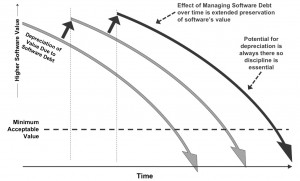
Michael did a great job of describing how companies may not consider the value of their existing software enough. Code has value and organizations who understand this can make better decisions about how they treat their software assets. The idea is to prevent devaluation of a software asset when appropriate.
Ron Jeffries & Chet Hendrickson
OK, now this was fun. Ron and Chet put on a artistic show that put technical debt into a perspective easily understood, IMHO. I will attempt to recreate their drawings and the reasoning behind each one but I hope they write an article on this soon since they are incredibly apt to delivering a message succinctly.

As a team is building a system their velocity will either stay fairly consistent, decelerate, or accelerate.

Each feature implementation is developed using a combination of available system capabilities and newly developed capabilities.

A team can choose within their current envioronmental context to build a rats nest that is hard to work with later or a well-designed system that more easily changes with new business needs.
The punch line, from what I could gather, was the use of a negative term “debt” may be problematic from an emotional point of view. Rather than using a negative to discuss the topic it may be better to discuss how we can build upon what we have. Thus we can call technical debt something like “liquid assets”. We can use our existing code to develop new capabilities for our business quickly and with lower cost then doing so from scratch. I am not sure if this term will stick but I like the building upon what we have already developed point of view.
Chet and Ron also brought up the 4 basic principles of simplicity in code by Kent Beck:
- Tests all run
- No duplication
- Expresses all design ideas
- Minimize code
* These are in order of importance since each of last 3 are potentially in conflict with each other.
Wrap Up
There is so much more that I didn’t take down, remember, potentially understood the importance of, and whatever else that stopped me from recording it. The above content may seem somewhat haphazard since I did not create a coherent overview but rather just recorded what I heard from my perspective. I hope it is still something that others can get some ideas from and use effectively. Lets start reducing technical debt for the good of our organizations and customers and the morale of our team.